

Albania is one of the last countries in Europe where a rental car still changes the whole trip. Buses reach the cities, but they do not reach the empty beach south of Himara, the mountain village above Theth, or the winery outside Berat. What stops most visitors is not the cost of the car. It is not knowing what driving in Albania actually involves once they leave the airport.
The short version: driving in Albania is far easier than its reputation suggests, and slightly harder than a first-time visitor expects. The main corridors are modern and well surfaced. The mountain roads are narrow and slow but perfectly drivable in an ordinary car. The real adjustment is the traffic culture, which runs on eye contact and confidence rather than written rules.
What the roads are actually like
Driving in Albania means moving between three distinct tiers of road, and knowing which one you are on tells you almost everything about the drive ahead.
The main corridors
The SH2 between Tirana and Durrës is a genuine four-lane highway and carries heavy traffic in both directions all day. The SH1 running north toward Shkodër and the A1 climbing northeast through the Kalimash tunnel toward Kosovo are both modern, well surfaced, and fast.
On these roads the surface is not the problem. The problem is that fixed speed cameras cover long stretches of the Tirana to Durrës run, and traffic police work the SH1 with mobile radar. Foreign plates attract attention.
Mountain and coastal roads
This is where most visitors form their opinion of driving in Albania. The SH8 down the Ionian coast, the climb to Korça, the approach to Theth: these are two-lane roads with tight bends, steep drops, and very little barrier. They are properly surfaced and they are not dangerous, but they are slow. Plan on averaging 45 to 55 km/h rather than the 80 your map application assumes.
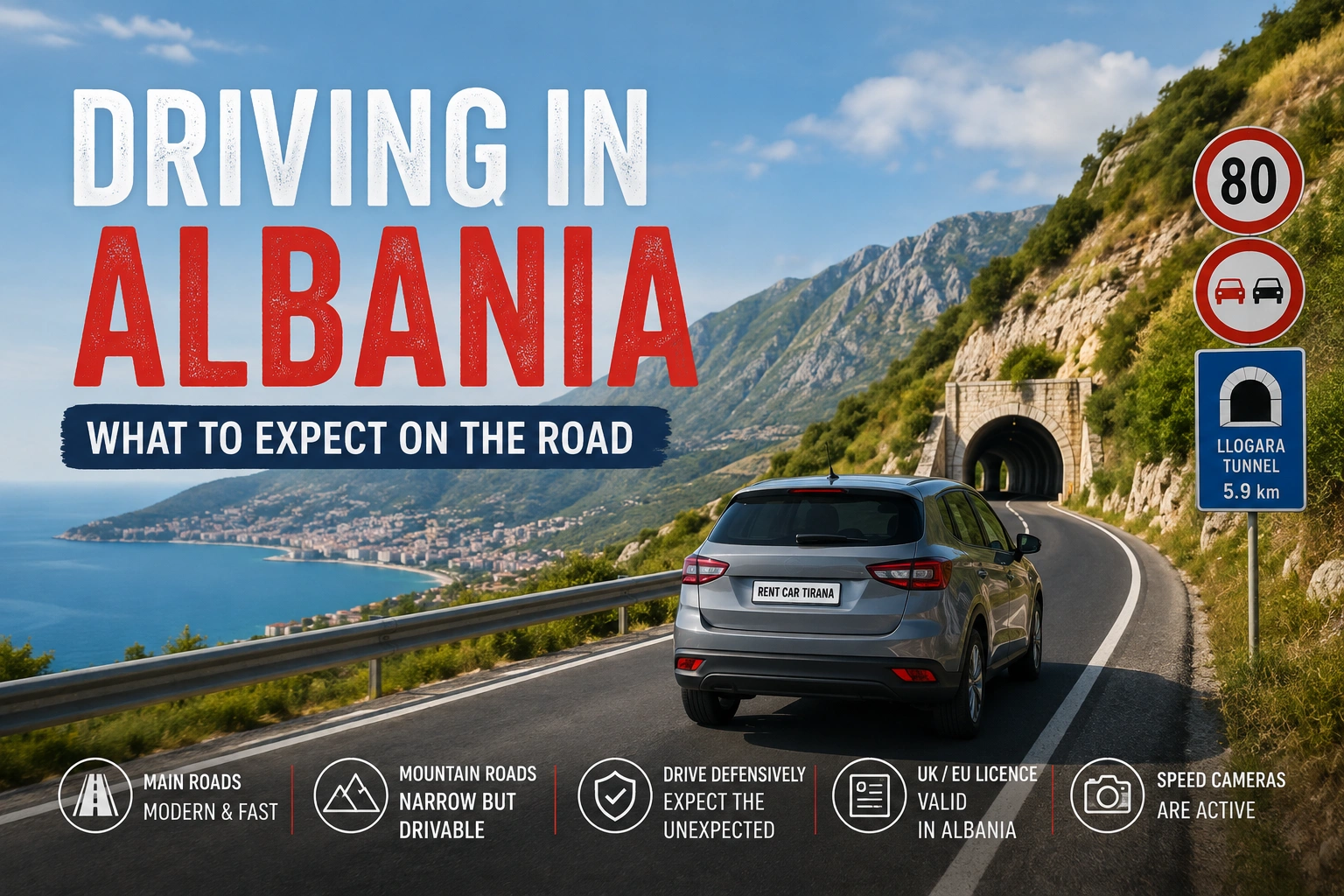
The Llogara section deserves a specific mention because the situation changed recently and most guides have not caught up. The Llogara Tunnel, 5.9 km between Dukat and Palasë, cuts a drive that took 30 to 45 minutes over the pass down to around 7 minutes. It carries a toll of roughly 250 lek per car each way and is closed to heavy vehicles. The old pass road over Qafa e Llogarasë is still open and still spectacular, so the tunnel is a choice rather than a replacement. Take the pass in daylight and good weather. Take the tunnel in rain, in fog, at night, or when you are tired.
Village and unpaved roads
Below the main network, surfaces vary from patched asphalt to gravel to riverbed. Some of the best destinations sit at the end of these. Two things matter here. Rural lighting is close to nonexistent, so an unlit road with an unmarked edge is a genuine hazard after dark. And almost every rental agreement in the country, including ours, restricts vehicles to paved public roads. If your plan involves a dirt track, ask before you book rather than after you get stuck. Matching the vehicle to the terrain you actually intend to cover is worth thinking about before you pick a car, not once you are staring at a track.
How Albanian drivers behave
Albania has a young driving culture. Private cars were effectively banned until 1991, which means the country compressed several decades of driving habits into one generation. The result is assertive rather than aggressive.
Expect overtaking with less margin than you would leave. Expect vehicles to pull out from side roads assuming you will adjust. Expect indicators to be treated as optional and horns to be used conversationally rather than angrily, usually meaning "I am here" rather than "you idiot". In villages, expect livestock, tractors, and pedestrians walking in the carriageway because there is no pavement.
None of this requires special skill. Driving in Albania requires leaving more space than you normally would and abandoning the assumption that other drivers will do the legally correct thing. Drive defensively, stay off other cars' bumpers, and the whole thing becomes unremarkable within a day.
The rules of driving in Albania that get enforced
Albania amended its Road Code on 7 August 2026, and the changes were substantial enough that advice published before that date is now out of date. Penalties rose across the board and several soft options were removed.
Can you drive in Albania on a UK or EU licence?
Yes. A full, valid UK or EU licence is legally sufficient for driving in Albania on a tourist stay, and this is the single most common question visitors ask. An International Driving Permit is recommended alongside it, particularly for licences issued outside Europe or not printed in Latin script, and some agencies ask for one as a matter of policy. If you want the detail on which permit applies to which licence, we cover international driving permits for Albania separately. Carry your passport as well: police checks on foreign plates are routine and they will ask for identification.
Speed limits
Limits are 40 km/h in built-up areas, 80 km/h outside them, 90 km/h on expressways, and 110 km/h on motorways. Signed limits override all of these, and they change more abruptly than you might expect, often dropping to 40 as you enter a village with no warning beyond the sign itself.
Under the amended code, drivers within their probationary period are capped at 90 km/h on highways regardless of the posted limit. Speeding in residential areas and near schools now carries penalties from 20,000 to 60,000 lek.
Alcohol, phones and seatbelts
The alcohol threshold is effectively zero. Albanian law (Article 184 of the Road Code) bans driving after drinking, and fines start below 0.3 g/l, so a single drink can already cost you. New drivers who have held a category B licence for less than 24 months face 0.0‰, a maximum of 90 km/h on motorways and 80 km/h outside towns, and fines of 5,000 to 15,000 lek plus a one-month suspension. Repeat offenders above 0.5 grams per litre now permanently lose their licence under the new code. There is no sensible way to drink and drive here, and no reason to try.
Handheld phone use is actively targeted, and a second offence within twelve months now brings a three-month licence suspension. Set your navigation before you move. Seatbelts are mandatory front and rear, and the fine applies per unbelted person.
One change worth knowing: the amended code removed the option to buy your way out of a licence suspension by paying double the fine. That escape route no longer exists.
Fines are issued as ranges, with police discretion inside them, and are reduced by half if paid within 15 days of registration. When a fine is issued electronically to a rental vehicle, it reaches the agency first and then you, usually with an administrative fee attached.
What the car must carry
Every vehicle must carry a warning triangle, a reflective vest, and a first aid kit. Spare bulbs are worth having as well, since dipped headlights are required during the day as well as at night. The fine falls on the driver, not the rental company, so check the boot before you leave the lot rather than discovering the gap at a roadside stop.
The emergency number is 112, free from any phone.
Fuel, tolls and parking
Fuel stations are dense along the main corridors and thin in the mountains. The practical rule is to fill up when you drop below half a tank anywhere south of Vlorë or north of Shkodër, rather than when you approach empty. Most stations are attended, cards are widely accepted on the main roads, and cash in lek is safer in rural areas.
Tolls are limited but not quite as limited as most guides suggest. Three points collect. The A1 booth near the Kalimash tunnel charges around 5 euros per car, though you only meet it heading north toward Kosovo. The Thumanë to Kashar section of the A1 charges 250 lek per car and sits on the route past Tirana airport, which makes it the one most visitors actually cross. The Llogara Tunnel charges 250 lek each way. Pay in lek where you can. Card lanes exist at the newer booths but are not worth relying on.
Parking is where visitors actually lose time, and Tirana is the worst of it. Paid zones, app-based payment, and limited street space make improvised parking a poor plan. Our Tirana parking map covers where to leave a car in the centre without collecting a ticket.
Tirana is the hardest part of the trip
This surprises people who were braced for the mountains. Open road driving in Albania is calm. Tirana is not. The Sheshi Skënderbej ring, unsignalled junctions, buses stopping in live lanes, and scooters filtering from both sides make the capital more demanding than anything on the coast.
The strategy that works is to avoid driving in the city at all. Collect the car when you leave Tirana and return it when you arrive back. If you do need to drive in the centre, our guide to navigating Tirana traffic covers the junctions and habits worth knowing in advance.
When you drive matters as much as where
Season changes driving in Albania more than any other single factor.
In July and August the coast road is genuinely congested, the heat is significant, and parking at popular beaches fills by mid-morning. Early starts solve most of this. We cover the specifics in our guide to summer driving along the Albanian Riviera.
In winter, mountain routes carry snow and ice, some high passes close, and daylight is short. Snow chains are expected between 1 November and 30 April, so confirm the car is equipped if you are heading inland. The coast stays drivable year round. If you are travelling in the cold months, our winter road trip guide covers which routes stay open.
In every season, the same rule holds: avoid long distances after dark. Unlit roads, unmarked edges, and livestock combine badly.
Choosing a car for Albanian roads
Driving in Albania does not require a four-wheel drive on the paved network, and most visitors who book one never use the capability. What matters more is ground clearance for rougher village approaches and a small enough footprint for old town streets and Tirana parking.
Transmission is the choice worth thinking about properly. Manual cars are cheaper and more widely available, but Albanian mountain roads involve constant gear changes, and Tirana traffic is stop-start. Our comparison of automatic and manual rentals sets out the trade-off, and terrain-matched vehicle selection covers the clearance question. If you want the short version of how to weigh size, transmission and cost together, our guide on choosing a rental car in Tirana does that, and you can see what is currently available across our fleet.
Where to point the car first
If this is a first trip, the two routes that show the most for the least difficulty are the coast and the southeast.
The run to the Ionian coast via Vlorë is the classic, and the Llogara Tunnel has made the southern half considerably easier. Our Tirana to Vlorë route guide breaks down the stages. Inland, the Tirana to Korça road trip is the quieter alternative, with mountain scenery and almost no tourist traffic.
For shorter trips, several worthwhile destinations sit within two hours of the capital. Our roundup of day trips from Tirana by car covers the practical ones.
Key Takeaways
- Main corridors are modern and fast. Mountain and coastal roads are properly surfaced but slow, so plan on 45 to 55 km/h rather than what your map application predicts.
- The Llogara Tunnel cuts the Dukat to Palasë section to around 7 minutes for 250 lek per car each way. The old pass road remains open and free.
- A full UK or EU licence is legally sufficient. An IDP is recommended alongside it, and essential for many non-European licences.
- The Road Code changed on 7 August 2026. Penalties rose, the alcohol threshold is effectively zero, and paying double to avoid a licence suspension is no longer an option.
- Every car must carry a warning triangle, reflective vest, and first aid kit. The fine falls on the driver, so check before leaving the lot.
- Rental agreements restrict vehicles to paved public roads. Confirm before booking if your plan involves unpaved tracks.
- Tirana is harder than the open road. Collect the car on your way out of the city where you can.
- Avoid long distances after dark. Unlit roads, unmarked edges, and livestock are the main night hazards of driving in Albania.